Here’s something no one tells you before you become a parent: the kitchen is one of the best classrooms in your home. Not in a Pinterest-perfect, everything-is-colour-coordinated kind of way, but in a real, messy, your-toddler-just-dumped-a-bowl-of-flour way.
Montessori food prep isn’t a trend. It’s a philosophy. And it’s one that’s been quietly transforming the way parents and caregivers think about what toddlers are actually capable of doing, which, as it turns out, is quite a lot.
If you’ve ever handed your two-year-old a banana and watched them try to peel it with the focused intensity of a neurosurgeon, you already know that something real is happening in that little mind. They want to do things. They want to help. And when we let them, really let them, the results are often far more meaningful than we expect.
This isn’t about producing tiny chefs. It’s about building people, curious, capable, independent little people who know that food comes from somewhere, that effort matters, and that their contributions count.
Why the Kitchen? Of All Places, Why There?
You’d be forgiven for thinking the kitchen is the last place you’d want a toddler. Knives, hot surfaces, breakable things, it’s a perfectly reasonable concern. But Montessori educators have long argued that the kitchen, when properly set up for small people, is one of the richest sensory and developmental environments a young child can access.
Think about what happens when a toddler helps wash vegetables. They’re feeling different textures, the waxy smoothness of a pepper, the rough skin of a potato, the feathery tops of a carrot. They’re listening to the sound of running water. They’re smelling the earthy scent of root vegetables. That’s multi-sensory learning happening without a single flashcard in sight.
And fine motor skills? Stirring, pouring, tearing lettuce, pressing a cookie cutter, mashing a ripe avocado, every one of those actions is strengthening the small muscles in your child’s hands and fingers, muscles they’ll rely on later for writing, drawing, and countless other tasks.
There’s also something harder to measure but just as real: the pride. When a child helps make something, even if it’s just tearing bread into a salad, they eat it differently. They own it in some small way. Parents who’ve spent years battling picky eating often report that involving their toddler in food prep changes the dynamic almost immediately. Not overnight, not perfectly, but genuinely.
What Montessori Actually Means (Without the Jargon)
Let’s be honest, the word ‘Montessori’ can feel a little intimidating if you haven’t grown up around it. It conjures images of beautiful wooden toys, specially trained teachers, and calm, linen-wearing children serenely sorting coloured beads. That world exists, and it’s lovely, but it isn’t the only version of Montessori.
At its heart, the Montessori approach, developed by Italian physician and educator Maria Montessori over a century ago, is about following the child’s natural drive to learn and to do. It’s about giving children real tools for real tasks, not simplified plastic imitations. It’s about trusting children with responsibility, at whatever level is appropriate for their age and development.
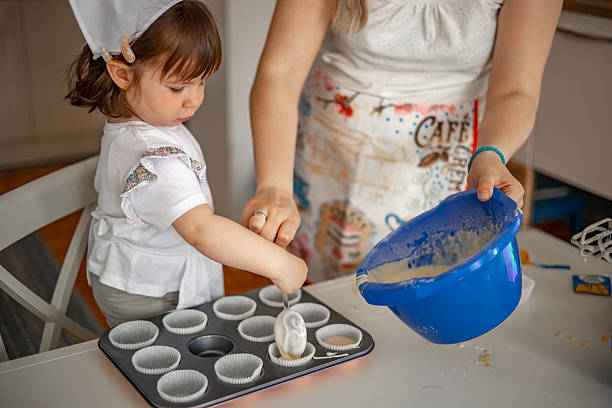
In a kitchen context, that means offering your toddler a child-sized cutting board and a safe, blunt knife, not a toy one and showing them how to cut a soft banana. It means letting them crack an egg, even if it goes everywhere the first twelve times. It means resisting the urge to jump in and fix what they’re doing, and instead narrating what you see: ‘You’re pouring the milk slowly. Look at that.’
The mess is the lesson. The effort is the point.
Getting Started: Setting Up Your Kitchen for a Small Person
Before you hand your toddler a whisk and step back, a little preparation goes a long way. You don’t need to overhaul your kitchen; just make a few thoughtful adjustments that help your child participate safely and independently.
A sturdy learning tower or step stool is probably the single most useful investment you’ll make. When children can stand at counter height alongside you, they’re not spectators, they’re participants. Brands like Learning Tower by Little Partners or Guidecraft make solid options, though a sturdy DIY step stool works just as well.
Beyond the step stool, think about:
- A small pitcher or jug is great for pouring practice, and essential for self-serving water or milk
- A child-safe knife brands like Opinel make a ‘Le Petit Chef’ set specifically designed for children
- A small apron, yes, it’s adorable, but it also signals to the child that something real is happening
- A low shelf or drawer where child-safe utensils live, their tools, and their access
- A small dustpan and brush, kept nearby because spills happen, and cleaning up is part of the activity
The Montessori setup philosophy is all about accessibility. If your child can get their own cup, pour their own water, and put their cup back without asking you, that’s independence. And independence, built gradually and safely, becomes confidence.
Activities by Age: What They Can Actually Do
This is where parents sometimes get it wrong, not through any fault of their own, but because we tend to underestimate toddlers. Here’s a rough guide, though every child develops at their own pace, and these are starting points, not rules.
12–18 Months: The Observer Who Wants In
At this age, your child is watching everything you do in the kitchen with enormous focus. They’re not passive observers; they’re cataloguing. The best thing you can do is narrate your actions. ‘I’m washing the apple. I’m rubbing it to get it clean. Now I’m drying it.’
Simple participation works beautifully at this stage. Let them:
- Wash fruits and vegetables with a small brush under running water
- Tear lettuce leaves or spinach into a bowl
- Stir things in a large bowl (with your hand guiding theirs at first)
- Rinse their own cup or small bowl
Keep sessions short, five to ten minutes is plenty. Their attention span is real but limited, and ending on a positive note matters far more than completing a task.
18–24 Months: Building Real Skills
This is when things start to get interesting. Toddlers in this window have enough physical coordination to manage tasks that feel genuinely useful, and they know it. The pride on a 20-month-old’s face when they successfully pour milk into their cereal is something you don’t forget.
Activities to try:
- Peeling bananas – genuinely achievable and very satisfying
- Pouring from a small pitcher into a bowl or cup
- Mashing soft foods – banana, cooked sweet potato, ripe avocado
- Spreading soft things with a butter knife or silicone spreader, cream cheese on toast, hummus on a cracker
- Snapping green beans or sugar snap peas
The snap of a fresh green bean is, for some reason, deeply satisfying to toddlers. Don’t ask why. Just let them snap.
2–3 Years: Now We’re Cooking
Two-year-olds are in what Montessori called the ‘sensitive period’ for order and routine — they love knowing what comes next and feel deeply satisfied when they can complete a sequence. Food prep is tailor-made for this.
At this age, children can take on more responsibility and more complex tasks. They can begin using a proper child-safe knife for cutting soft foods, such as banana slices, strawberries, and cooked potatoes. They can crack eggs into a bowl (again, expect shells for a while, that’s fine). They can help measure ingredients using measuring cups and spoons, which also sneaks in early maths concepts.
Great two-to-three-year-old activities include:
- Cutting soft fruits and vegetables with a child-safe knife
- Cracking eggs (into a bowl, not the pan, until they’ve got the hang of it)
- Using cookie cutters on soft dough or bread
- Measuring and pouring dry or liquid ingredients
- Whisking eggs or salad dressings
- Peeling hard-boiled eggs
- Assembling their own simple meals, a deconstructed plate where they choose what goes where
That last one is worth pausing on. Giving toddlers agency over what goes on their plate, even if the options are carefully curated by you, can significantly reduce mealtime battles. It’s not a trick. It’s respecting that they have preferences, and preferences deserve to be heard.
The Picky Eating Connection: Because We Have to Talk About It
You knew this was coming. Picky eating is probably the number-one food-related concern parents bring up, and for good reason; it’s stressful, it’s exhausting, and it can make every mealtime feel like a negotiation.
Here’s what the research and a lot of real-world experience tell us: children are more likely to eat foods they’ve helped prepare. Not guaranteed. More likely. There’s something about the investment of effort, however small, that shifts a child’s relationship with food.
A child who has washed, peeled, and mashed an avocado is not necessarily going to eat it. But they’re going to be curious about it. They might smell it. They might poke it. They might touch it to their lip and make a face. And that’s not failure, that’s exposure, and repeated neutral exposure to new foods is exactly how toddlers eventually learn to accept them.
Montessori food prep doesn’t promise a child who eats everything. It promises a child who has a healthy, low-anxiety relationship with food preparation, and that is an enormously valuable foundation.
Keeping It Safe Without Keeping Them Out
Safety in the kitchen with toddlers isn’t about removing every risk, but it’s about managing risk thoughtfully. The goal is a child who learns genuine caution, not one who is kept so far from any challenge that they develop no judgment at all.
Some practical ground rules that work well:
- Hot things are not toddler territory – be clear and consistent about this. ‘The stove is hot. That’s for grown-ups.’ No exceptions.
- Sharp knives are stored out of reach – but child-safe knives can and should be accessible for food prep activities.
- Always supervise – this goes without saying, but Montessori independence doesn’t mean leaving a toddler alone in the kitchen.n
- Clean as you go – modelling tidy habits is part of the activity, not an afterthought.
- Let them clean up their spills with their own small cloth, kept at child height.t
That last one is huge. When a child spills something and learns to clean it up themselves, they’re not being shamed; they’re being trusted with responsibility. The response you model in that moment (‘Oh, you spilt some milk. Let’s get your cloth’) shapes how they’ll approach mistakes for years.
Real Activities to Try This Week
Enough theory, let’s get practical. Here are some specific food prep activities that work well in a Montessori-inspired home kitchen, with minimal prep and maximum toddler engagement.
The Fruit Washing Station
Set up a small tub of water on a low table or at the sink with a step stool. Give your toddler a selection of fruits and a small produce brush. Their job: wash everything before it goes in the fruit bowl. This is ideal for 18 months and up, takes about ten minutes, and results in very clean fruit. Win.
The Banana Slicing Station
A ripe banana, a child-safe knife (the Opinel Le Petit Chef Kiwi knife is perfect for this), and a small cutting board. Show your toddler once how to hold the banana steady with one hand and press the knife down with the other. Then step back. The banana is soft enough that a child-safe knife handles it easily, and the slices become part of a fruit salad or morning yoghurt bowl.
The Egg Scramble
Two eggs in a bowl. A small whisk. A toddler who is absolutely going to take this very seriously. Let them crack the eggs (over a separate bowl first, to fish out any shell), add a tiny pinch of salt, and whisk until combined. You handle the pan and heat. They made breakfast. That matters.
The Salad Assembly Line
Lay out pre-washed salad components in small bowls: cherry tomatoes, cucumber slices, torn lettuce, and shredded carrot. Give your toddler a large salad bowl and let them assemble. They choose what goes in, how much of it, and where. You add the dressing. This works brilliantly for three-year-olds and gives them enormous satisfaction, and the salad is genuinely edible.
The Smoothie Pour
Make a simple smoothie together: a banana, yoghurt, a handful of berries, and some milk. You manage the blender. Then let your toddler pour the smoothie from a small jug into their cup. Use a jug that’s sized appropriately, not so full it’s unwieldy, not so small that it feels like a trick. The control and precision required is genuinely challenging and genuinely rewarding.
When It Goes Wrong (Because It Will)
Flour on the floor. Egg on the wall. A carefully poured glass of water that went mostly sideways. This is part of it. This is actually the most important part of it.
How you respond to these moments, and you will have a lot of them, shapes everything. The Montessori approach asks you to stay calm, involve the child in the cleanup, and resist the urge to say ‘Let me do it.’ Not because making messes is fine (they’re not ideal), but because how a child experiences failure determines whether they’ll try again.
A child who spills and gets quietly helped to clean up, without drama or punishment, learns that spills are manageable. A child who spills and gets a big reaction, positive or negative, learns that spills are events. And events are exhausting.
Keep a small towel at toddler height. Keep your voice even. Keep going.
A Note on What You’re Actually Building
It’s easy to look at Montessori food prep activities as a collection of cute tasks, things to do with a toddler on a rainy afternoon, content for a parenting blog, a way to keep them busy while you make dinner.
But you’re building something much bigger than that.
You’re building a child who believes they are capable. Who approaches new tasks with curiosity rather than fear. Who understands, even if they can’t articulate it, that things take effort, and effort is satisfying.
You’re building a relationship with food that isn’t anxious or adversarial. One where the kitchen is a place of collaboration, not conflict. Where trying new things is normal, and making something for someone else is one of the great joys in life.
And honestly, you’re giving yourself something too. A few minutes of genuine connection in the middle of a busy day. A shared task. A small person looking up at you with their hands covered in mashed banana, absolutely beaming.
That’s worth a bit of mess.
Quick Reference: Montessori Food Prep by Age
12–18 Months: Washing fruits and vegetables, tearing soft foods, stirring with guidance, rinsing dishes.
18–24 Months: Peeling bananas, pouring from small jugs, mashing soft foods, spreading with a blunt knife, snapping green beans.
2–3 Years: Cutting soft foods with a child-safe knife, cracking eggs, using cookie cutters, measuring ingredients, whisking, assembling simple meals.
One Last Thing Before You Go
You don’t need to do this every day. You don’t need to do it perfectly. You don’t need a specially designed Montessori kitchen or an expensive set of child-sized tools.
You just need to say ‘yes’ a little more often when your toddler pulls at your sleeve and says, ‘Me do it.’ Because that instinct that fierce, determined ‘me do it’ is something precious. And the kitchen is one of the best places in your home to honour it.
Start small. Start messy. Start today.