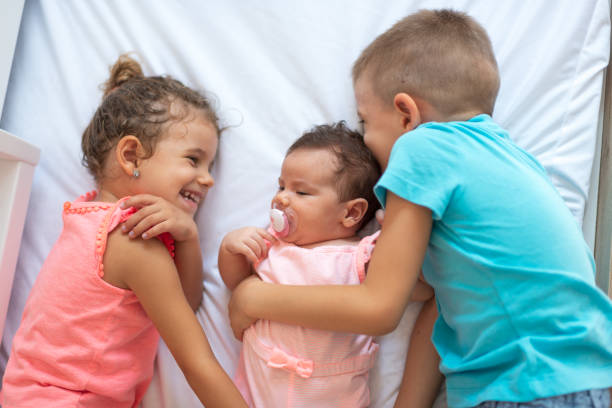
A calm, honest guide for parents who love all their kids and still worry constantly
Bringing a newborn home when you already have kids feels a bit like adding a candle to a cake that’s already lit. Beautiful, warm, hopeful… and yes, a little nerve-racking.
You’re watching tiny fingers curl around yours while, in the background, your toddler is jumping off the couch for sport. Your older child wants to help. Your middle child suddenly needs you right now. And you’re standing there thinking, How do I keep this tiny human safe without crushing everyone else’s spirit?
Honestly? If that thought has crossed your mind, you’re doing better than you think.
Keeping a newborn safe around siblings isn’t about control. It’s about awareness, pacing, and a whole lot of grace for them and for you.
Let me explain.
Why siblings change the safety equation (even loving ones)
Here’s the thing people don’t say out loud: most sibling-related newborn injuries aren’t caused by malice. They’re caused by love mixed with impulse, curiosity, and poor motor control.
Siblings don’t see a newborn as fragile. They see a baby as:
- A doll that moves
- A prize that gets attention
- A loud mystery
- A new rule-set they didn’t agree to
And developmentally? That makes perfect sense.
A three-year-old hugging too hard isn’t being rough. They’re being three. A five-year-old trying to “fix” the baby’s crying is problem-solving, not plotting.
So safety starts with understanding, not fear.
A quick age-by-age reality check (no sugarcoating)
Toddlers (1–3 years): pure impulse, zero brakes
Toddlers are the most unpredictable around newborns. Not because they’re mean, but because their brains haven’t wired in restraint yet.
They might:
- Grab the baby’s face
- Drop toys near the head
- Try to climb into the bassinet
- Sit on the baby (yes, really)
Key truth: Toddlers and newborns should never be together without an adult within arm’s reach. Not across the room. Not “just for a second.”
Preschoolers (3–5 years): eager helpers, shaky execution
This age wants to participate. They also overestimate their abilities.
They may:
- Pick up the baby without asking
- Cover the baby with blankets
- Try to feed or soothe independently
They need guidance, scripts, and repetition, lots of it.
School-age kids (6–10): capable but emotional
Physically, they’re safer. Emotionally? That’s where things get interesting.
They might act out when attention shifts. Or go silent. Or become overly responsible.
Their safety risk usually comes from emotional overload, not physical mishandling.
Teens: often overlooked, often amazing
Teen siblings are usually safe physically. The risk here is distraction, phones, headphones, and multitasking.
Clear expectations still matter. So does appreciation.
Start before the baby arrives (yes, even late)
If you’re still pregnant, this is a good time. If the baby is already here? Don’t worry. You can still reset.
Talk about what babies can’t do
Instead of saying “Be careful,” try specifics:
- “Babies can’t hold their heads up.”
- “Babies breathe through tiny noses.”
- “Babies can’t tell us when something hurts.”
Concrete facts land better than vague warnings.
Practice with real objects
Use a doll. A pillow. Even a rolled towel.
Show:
- How to touch gently
- Where not to touch (face, soft spot)
- How to sit while holding
Make it boring. Repetition works.
The first day at home: excitement is the biggest hazard
Those early days are electric. Everyone wants to see the baby. Touch the baby. Claim the baby.
This is when accidents happen,n not because kids don’t care, but because the moment feels big.
A few ground rules that actually help:
- One sibling at a time near the baby
- Sitting only, never standing
- Hands checked before contact
- Short interactions (end on a good note)
And yes, you’ll repeat this a hundred times. That’s normal.
Supervision without hovering (a real parenting skill)
You don’t need to narrate every move. You do need proximity.
Think of it like lifeguarding. Calm, alert, close enough to intervene without panic.
Helpful phrases:
- “I’m right here.”
- “Let me help you.”
- “That’s not safe. Try this instead.”
Avoid yelling unless there’s immediate danger. Loud reactions can scare kids into freezing or repeating the behaviour later.
Hands, germs, and boundaries (without turning into the fun police)
Newborn immune systems are… let’s say unfinished.
Siblings don’t need to live in a bubble, but they do need structure.
- Wash your hands before touching the baby
- No kisses on the face or hands
- Coughs and colds mean distance, not shame
Make it routine, not emotional. A simple “Baby rule” list posted on the fridge can work wonders.
Teaching safe touch (and correcting unsafe moments)
Safe touch is specific:
- Gentle strokes on the back
- Holding feet, not hands
- One-finger touch for toddlers
When unsafe touch happens, it will correct the action, not the child.
Instead of:
“Why would you do that?!”
Try:
“I won’t let you touch the baby like that. Here’s how we do it safely.”
Boundaries land better when they’re calm.
Sleep, noise, and overstimulation
Babies need rest. Siblings need movement. This is where friction lives.
You don’t need silence. You need predictable, calm windows.
Ideas:
- “Quiet time” during naps
- Headphones for loud play
- Special activities reserved for baby’s sleep times
This isn’t about catering to the baby. It’s about rhythm.
Jealousy is normal, and it can affect safety
Jealous kids don’t always say “I’m jealous.”
They say:
- “The baby is boring.”
- “I don’t like you anymore.”
- “I hate this baby.”
Or they act out physically near the baby.
The fix isn’t punishment. It’s a connection.
Daily one-on-one time even ten minutes, reduces risky behaviour more than lectures ever will.
When siblings want to help (use this wisely)
Helping can be a safety asset if it’s structured.
Safe helper tasks:
- Fetching diapers
- Singing to the baby
- Choosing outfits
- Timing tummy time
Unsafe tasks:
- Carrying the baby
- Feeding without supervision
- Adjusting sleep setups
Praise effort, not outcome. “Thank you for being gentle” goes further than “Good job.”
Create physical safety zones at home
Design matters more than we admit.
Consider:
- Baby-only spaces (bassinet zones)
- Toddler-proof gates
- Floor mats for sibling play nearby
You’re not separating kids, you’re creating clarity.
Real scenarios parents whisper about
Let’s be real for a second.
- A sibling drops a toy on the baby
- Someone sits too close
- The baby rolls off a couch during “helping”
If something happens:
- Check the baby calmly
- Call a professional if unsure
- Address the behaviour later
Panic teaches fear. Calm teaches responsibility.
Culture, family roles, and safety expectations
In some cultures, siblings are caregivers early age. In others, they’re protected from responsibility.
There’s no single right way, but safety basics still apply everywhere.
Adjust expectations without assuming kids know what’s safe. Teach explicitly.
Long-term safety builds long-term bonds
Here’s the quiet truth: kids who are taught how to be gentle grow into siblings who are protective, not resentful.
Safety doesn’t weaken bonds. It strengthens them.
One last thing, because parents need to hear this
You’re going to miss something. You’ll turn your back. You’ll intervene too late once or twice.
That doesn’t mean you failed.
It means you’re human, raising humans, in a loud, busy house full of love.
And that? That’s a pretty safe place to grow up.
