Why the Playroom Matters More Than We Think
Most parents imagine a playroom as a place where toys go. Maybe a basket here, a shelf there, a colourful rug in the middle. Done.
But if you watch a toddler closely, really watch, you’ll notice something interesting. Children don’t just play in a room. They interact with it.
They test it. They climb it. They explore its corners like tiny scientists.
The environment quietly shapes their behaviour.
This idea sits at the heart of the Montessori philosophy developed by Maria Montessori. She believed the child’s surroundings act like a silent teacher. When the environment invites independence, children naturally become more capable.
When the environment overwhelms them… well, tantrums appear faster than you’d expect.
A thoughtfully arranged Montessori playroom isn’t about aesthetics or Pinterest perfection. It’s about creating a space where children can think, explore, and act without constant adult direction.
And the surprising part?
You don’t need a huge house, fancy toys, or a big renovation. Often, the most effective Montessori rooms look simple, almost minimal.
Let’s walk through how parents actually set them up.
What Makes a Playroom “Montessori”? (It’s Simpler Than You Think)
People sometimes imagine Montessori spaces filled with specialised wooden materials and expensive shelves. But honestly, that’s only a small part of it.
The real principles are surprisingly straightforward.
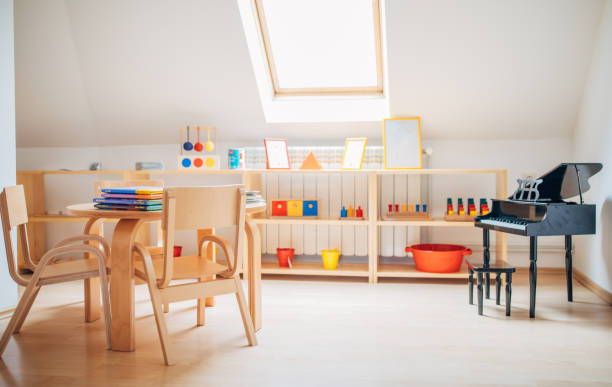
A Montessori playroom usually includes:
• Low, accessible furniture
• A limited number of toys displayed neatly
• Natural materials whenever possible
• Clear organisation
• Freedom for the child to move and choose activities
That’s it.
Think of the room as a child-sized world.
When everything is reachable and understandable, children feel capable. When everything is hidden in bins or piled into toy chests, they feel lost.
Here’s a small experiment many parents try.
Put 20 toys on the floor.
Now watch your child.
They’ll likely jump from toy to toy without settling.
Now try three toys.
Suddenly, play deepens.
It’s strange, but it happens all the time.
Less stimulation often creates more meaningful play.
Start With the Floor. The Real Centre of Play
Adults love tables.
Children? Not so much.
Toddlers instinctively play on the floor because it gives them space to move, twist, crawl, stretch, and build.
So the first step in a Montessori playroom setup is surprisingly basic: protect and celebrate the floor.
A few simple ideas:
• Soft neutral rug for building and puzzles
• A floor mattress or cushion for reading
• Open space for movement
Movement is crucial in early development. Gross motor skills, rolling, crawling, and balancing, form the physical foundation for later coordination.
Parents sometimes worry that the room looks too empty.
But space isn’t wasted space.
It’s thinking space.
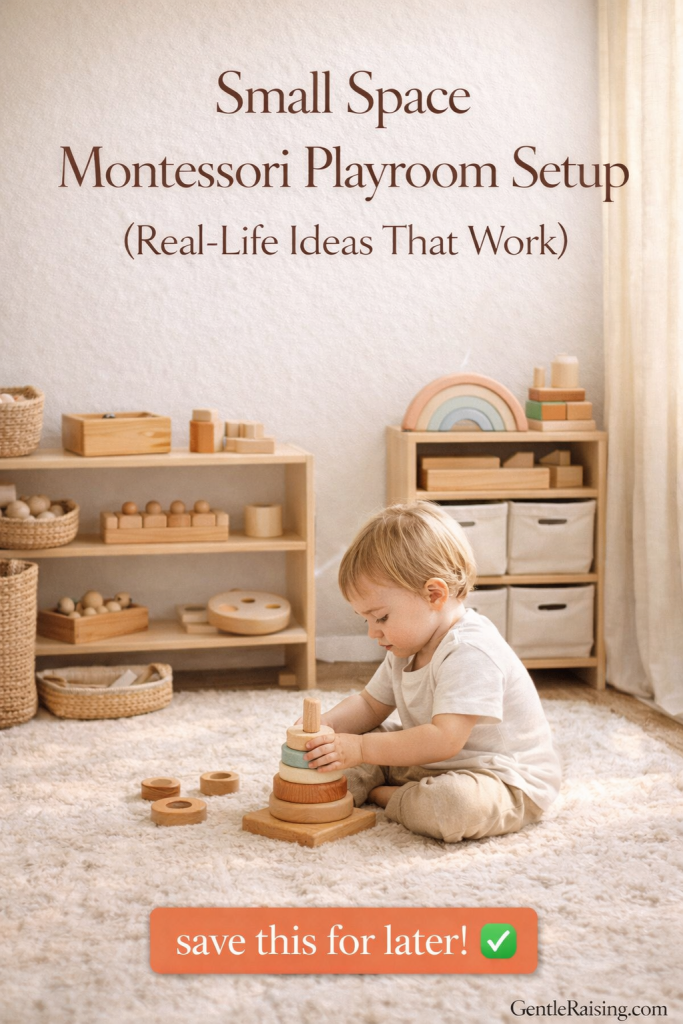
Low Shelves: The Quiet Secret to Independent Play
If Montessori playrooms had a single signature feature, it would probably be low shelves.
Why?
Because shelves change how children interact with toys.
Instead of digging through a toy box like archaeologists, children can see everything clearly.
The result:
• Better focus
• More intentional play
• Less mess
Popular shelving options parents use include pieces from IKEA, especially the IKEA KALLAX shelf unit, which happens to sit at a perfect toddler height.
Each shelf typically displays 3 to 6 activities.
That’s all.
And each activity has a defined place. A puzzle tray. A basket with blocks. A small wooden stacking toy.
This kind of visual clarity helps children understand where things belong.
It also makes cleanup surprisingly easy.
Toy Rotation (Or: Why Fewer Toys Create More Play)
Let’s talk about toy overload.
Most children today own far more toys than earlier generations. Birthdays, holidays, well-meaning relatives—it adds up quickly.
But too many toys often produce the opposite of what parents want.
More toys → shorter attention spans.
Montessori rooms solve this with toy rotation.
Instead of keeping everything out, parents store most toys away and rotate them weekly or bi-weekly.
A simple rotation system looks like this:
• Shelf displays 6–8 activities
• Storage bin keeps extra toys
• Swap items every 1–2 weeks
The child experiences the toys as “new” again.
It’s like rediscovering a favourite book after a few months.
Honestly, parents often notice something else, too.
Their children begin playing longer and more calmly.
Learning Zones (Without Turning the Room Into a Classroom)
Montessori environments are carefully structured, but they never feel like school.
The goal is to create natural zones for different types of activity.
A few simple examples:
Reading Corner
A cosy floor cushion and a small front-facing bookshelf.
Children choose books easily when the covers face outward. Furniture like the Montessori book display shelf makes this simple.
Add soft lighting and maybe a stuffed animal.
Suddenly, reading feels like an invitation.
Practical Life Area
This is where Montessori really shines.
Practical life activities include simple, real-world tasks:
• pouring water
• wiping tables
• folding cloths
• sorting objects
You might add a small tray with child-size tools from Melissa & Doug or Lovevery.
Children love doing real tasks. It gives them purpose.
Creativity Space
Art doesn’t need a giant setup.
A small table with:
• crayons
• paper
• washable paints
Simple tools often lead to the most imaginative work.
Movement Area
Toddlers need to climb, balance, and stretch.
Some families add climbing structures like the Pikler triangle, originally inspired by paediatrician Emmi Pikler.
It looks simple, but it builds strength and confidence.
Montessori Materials That Actually Matter
Now here’s a small contradiction.
Montessori philosophy emphasises specific materials, but you don’t actually need many of them.
The most important toys are open-ended.
Meaning they can be used in many ways.
Great examples include:
• wooden blocks
• stacking rings
• shape sorters
• nesting cups
• simple puzzles
Brands like Grimm’s Spiel und Holz Design and Hape focus on this style of play.
Open-ended toys encourage imagination because they don’t dictate the outcome.
A block can be a tower. Or a road. Or a castle wall.
The child decides.
What Children Should See on the Walls
Adults tend to decorate playrooms for themselves.
Bright posters. Busy colors. Cartoon characters everywhere.
But children often focus better in calm environments.
A Montessori wall setup typically includes:
• Child-height artwork
• Simple nature prints
• A safe mirror
Mirrors are surprisingly valuable.
They help babies and toddlers develop body awareness.
And if you place art at a child’s level, not an adult’s level, something interesting happens.
Children actually notice it.
Lighting and the “Calm Room Effect”
Lighting can quietly shape the emotional tone of a room.
Harsh overhead lights often create overstimulation.
Instead, Montessori playrooms lean toward:
• natural sunlight
• warm lamps
• neutral colour palettes
Soft greens, warm wood tones, gentle beige, these colours signal calm to the brain.
Honestly, parents often say something funny about Montessori spaces.
They feel calmer themselves.
The room works for adults, too.
Small Spaces? Montessori Still Works
Many parents assume Montessori requires a dedicated playroom.
It doesn’t.
In apartments or smaller homes, families simply integrate Montessori principles into living spaces.
For example:
• one low shelf in the living room
• toy basket beside the couch
• reading nook in a bedroom corner
Even a single organised shelf can dramatically change how a child interacts with toys.
It’s not about square footage.
It’s about intentional space.
Real-Life Parent Hacks for Keeping the Room Organised
A Montessori playroom stays functional because of simple routines.
Parents often use quick reset habits:
• 5-minute evening cleanup
• toy rotation every two weeks
• returning items to trays after play
Another helpful trick?
Teach children where items belong.
When each toy has a clear place, cleanup becomes part of play rather than a separate chore.
You’d be surprised how young children can manage this.
Common Montessori Playroom Mistakes
Even well-intentioned parents sometimes miss the mark.
A few common pitfalls show up again and again.
Too Many Toys
More toys rarely equal better play.
Children focus best when choices are limited.
Designing for Pinterest Instead of the Child
Perfectly styled rooms sometimes look beautiful, but lack practical use.
Children need access, movement, and durability.
Not museum displays.
Overly Structured Activities
Montessori supports freedom.
If every toy has one strict purpose, creativity disappears.
Balance matters.
A Room That Grows With Your Child
The most beautiful thing about a Montessori playroom?
It evolves.
A baby might start with mirrors, soft mats, and grasping toys.
A toddler adds puzzles and climbing structures.
A preschooler introduces art supplies, early math materials, and more complex building sets.
The environment adapts as the child grows.
And along the way, something subtle happens.
Children begin trusting their own curiosity.
They explore more deeply. They solve problems. They build concentration.
And parents notice something else, too.
Play becomes calmer.
Longer.
More thoughtful.
Which, if you’re a parent, might be the greatest benefit of all.