You know that moment.
You buy a toy that looks incredible in the box, with lights, sounds, and buttons everywhere. Your child plays with it for about seven minutes. Maybe eight.
Then it sits in the corner.
Honestly, most parents experience this cycle at least once. Sometimes dozens of times.
Meanwhile, a random cardboard box suddenly becomes a spaceship. Or a wooden spoon becomes a drumstick. Or a pile of cushions transforms into a pirate ship.
It’s not an accident.
Children naturally gravitate toward open-ended play activities where there isn’t one fixed way to play. Toys that don’t dictate the outcome invite children to think, imagine, and experiment.
And that’s exactly why certain toys seem to stay relevant for years while others fade within weeks.
Let’s talk about those magical few, the toys that quietly grow alongside your child.
First Things First: What Is an Open-Ended Toy?
Let me explain.
An open-ended toy is any toy that allows multiple ways to play. There’s no single correct result, no rigid instructions, no flashing arrow saying “press here.”
Children decide what the toy becomes.
Blocks become towers today… and a zoo tomorrow.
A scarf becomes a superhero cape, a baby blanket, or a picnic tablecloth.
Even a simple stick can become a fishing rod, sword, wand, or magic staff, depending on the story unfolding in your child’s mind.
That freedom is the key.
Unlike many modern toys, open-ended materials don’t perform for the child. Instead, the child performs with them, building stories, experimenting, and creating worlds.
And strangely enough, the simpler the toy… the more possibilities it holds.
Why Some Toys Last Years (And Others Last Weeks)
Here’s a small parenting paradox.
The toys that seem boring to adults often become the most beloved.
Why?
Because children are natural designers.
When a toy already does everything, lights, sounds, animations, there isn’t much room left for imagination.
But open-ended toys leave that blank space.
And kids fill it beautifully.
Educational researchers often note that toys like blocks, figurines, or art materials allow children to experiment with spatial reasoning, storytelling, and problem-solving all at once.
In other words, the toy doesn’t change.
The child’s thinking changes.
Which means the same toy evolves with them.
Watching a Toy Grow With Your Child
This is the part many parents find fascinating.
The same toy looks completely different at different ages.
Let’s walk through a typical example.
12–18 months
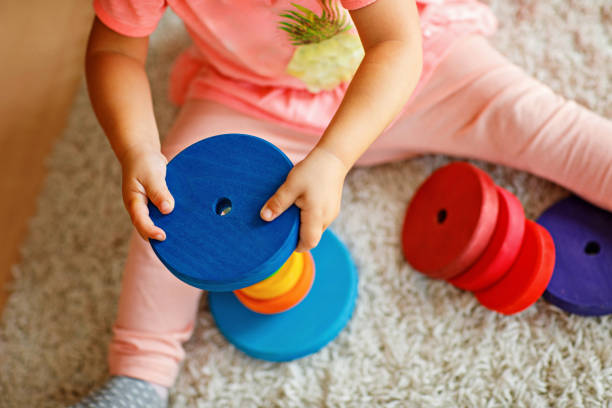
A toddler receives a wooden block set.
They:
- knock towers down
- Bang pieces together
- carry blocks across the room
- chew on one (because toddlers)
Messy? Yes.
Meaningless? Not at all.
They’re learning grip strength, balance, and cause-and-effect.
2–3 years
Suddenly, the blocks become:
- houses
- bridges
- train tunnels
- “cakes” for pretend birthdays
The child begins storytelling.
Language grows. Imagination wakes up.
4–6 years
The same blocks become:
- cities
- castles
- marble runs
- elaborate obstacle courses
Now engineering skills appear, such as balance, symmetry, and problem-solving.
Blocks are actually a classic example of open-ended play because children can sort, build, count, and invent endless structures with them.
And the toy hasn’t changed at all.
Only the child has.
The Quiet Science Behind Open-Ended Play
You might hear educators talk about child-led learning.
It sounds technical, but the concept is simple.
Children learn best when they control their exploration.
Open-ended toys naturally encourage that process because they don’t prescribe steps.
A child experiments, adjusts, and tries again.
Trial and error builds:
- problem solving
- attention span
- creativity
- resilience
Many educational philosophies, from Montessori to Waldorf, favour toys that allow children to explore without constant adult instruction.
And interestingly, when children lead their own play, they often stay focused much longer.
You’ve probably seen it.
A child deeply absorbed in building something… quietly muttering their story as they go.
That’s real learning happening.
Creativity Begins With “Nothing Special”
Here’s something funny.
If you walk into many thoughtfully designed playrooms, you won’t see dozens of toys.
Instead, you’ll notice:
- wooden blocks
- scarves or play silks
- figurines
- art materials
- loose pieces
At first glance, it looks… simple.
But that simplicity is intentional.
Loose parts, small objects, children can combine and rearrange, encourage experimentation and storytelling without predetermined outcomes.
Which means every play session becomes different.
And kids never really “finish” playing with them.
Open-Ended vs. Single-Purpose Toys
Let’s compare for a moment.
A single-purpose toy
A puzzle.
You solve it once.
Maybe twice.
Then the brain says, Okay, we already know this.
Play value declines quickly.
An open-ended toy
Wooden animals.
Today they’re farm animals.
Tomorrow they’re dinosaurs.
Next week they’re characters in a jungle rescue mission.
Same toy.
New story.
Again and again.
That’s the secret.
The Best Open-Ended Toys (That Actually Grow With Kids)
You don’t need dozens.
Honestly, a small rotation works better.
Here are some that consistently stand the test of time.
1. Wooden Blocks (The Timeless Classic)
If there’s one toy nearly every educator recommends, it’s blocks.
Children use them for:
- stacking
- counting
- building
- balancing
- storytelling
They support spatial reasoning, coordination, and engineering thinking.
Popular options parents love include:
- Grimm’s wooden blocks
- Melissa & Doug unit blocks
- Lovevery block sets
- Guidecraft block collections
The exact brand matters less than the concept.
Simple blocks. Endless play.
2. Play Silks (The Ultimate Imagination Booster)
If you’ve never seen play silks in action, it’s delightful.
They become:
- superhero capes
- Rivers for toy animals
- picnic blankets
- baby doll wraps
- magic carpets
The soft texture also adds sensory play, which many toddlers find calming.
Brands like Sarah’s Silks have become favourites among parents for this reason.
3. Animal Figurines
Tiny animals open the door to storytelling.
A lion meets a farmer.
A giraffe visits a castle.
A dinosaur wanders into a pretend grocery store.
Children build narratives naturally when they have small characters to animate.
These little figures help develop language skills and imaginative storytelling during play.
Popular brands include:
- Schleich
- Safari Ltd.
- Papo
4. Magnetic Tiles and Building Sets
Magnetic tiles are basically engineering toys disguised as fun.
Kids build:
- towers
- bridges
- marble runs
- rockets
And without realising it, they’re learning symmetry, geometry, and balance.
Many parents swear by brands like Magna-Tiles or Picasso Tiles because they work across many ages.
5. Art Supplies
Honestly?
Crayons and paper might be the most underrated toys in the house.
Drawing, painting, and sculpting clay allow children to express emotions and ideas without instructions.
Art materials are one of the most flexible open-ended tools because children invent their own projects every time.
6. Loose Parts (Nature’s Version of Toys)
You don’t even need to buy everything.
Nature provides incredible open-ended materials.
Think:
- stones
- pinecones
- sticks
- shells
- leaves
Suddenly, a child is building fairy houses or tiny villages.
Outdoor play quietly becomes an engineering practice.
A Small Digression: The Toy Industry Knows This
Here’s something interesting.
Many toy companies now advertise “open-ended play.”
And some products really do support it.
But others… well, they’re mostly marketing.
A good rule of thumb:
If the toy tells the child exactly what to do, it probably isn’t open-ended.
If the child must invent the activity themselves, now you’re on the right track.
Introducing Open-Ended Toys at Home
You don’t need to replace everything overnight.
In fact, that usually overwhelms kids.
Instead, try a slow shift.
Step 1: Reduce toy clutter
Too many toys actually reduce creativity.
Children jump from toy to toy instead of exploring deeply.
Step 2: Rotate toys
Keep only a few available.
Store the rest.
Every few weeks, swap them out.
Suddenly, the old toys feel new again.
Step 3: Let children lead
This part matters.
Try not to demonstrate every possible use.
Children often invent better ideas than adults anyway.
A Small Truth Parents Sometimes Miss
Open-ended play can look… messy.
Blocks everywhere.
Animals mixed with kitchen toys.
Scarves hanging off chairs.
But that mess is usually a sign that something good is happening.
A story is unfolding.
A problem is being solved.
A small imagination is stretching.
And those moments matter more than a tidy playroom.
Seasonal Open-Ended Play (Because Kids Love Change)
Here’s a fun idea many families enjoy.
Adjust play materials slightly with the seasons.
Autumn
- leaves
- acorns
- small pumpkins
Winter
- cotton “snow”
- wooden animals
- scarves
Spring
- flowers
- pebbles
- small garden tools
Summer
- water tables
- sand
- shells
Children naturally weave these materials into their stories.
The Surprising Truth About How Many Toys Kids Need
Not many.
Some childhood educators suggest children play better with fewer, more flexible toys rather than a mountain of single-purpose ones.
Why?
Because imagination fills the gaps.
Give a child three simple objects… and they’ll build a world.
Give them fifty toys that all do something specific…
…and they might just press buttons.
When Open-Ended Toys Shine the Most
These toys become especially valuable during certain moments:
- rainy afternoons
- quiet independent play
- sibling cooperative play
- travel days
- long winter evenings
They adapt.
That flexibility is their greatest strength.
Final Thoughts: The Toys Kids Remember
Years later, most adults don’t remember electronic toys.
They remember things like:
- building forts
- stacking blocks
- playing pretend with dolls
- creating imaginary worlds
Simple materials become the backdrop of childhood stories.
Open-ended toys quietly encourage that kind of play, where imagination takes the lead and learning follows naturally.
And honestly?
Those are the toys that grow with your child the longest.
Sometimes from babyhood…
all the way into grade school.