Why Independent Play Matters More Than We Think
If you’ve ever watched a toddler deeply absorbed in stacking blocks or carefully fitting puzzle pieces together, you’ve probably noticed something interesting.
They’re quiet. Focused. Completely in their own little universe.
And honestly? It’s kind of magical.
Independent play, that beautiful stretch of time when a child explores the world without constant adult direction, is one of the most valuable skills a young child can develop. Yet many parents feel unsure about how to encourage it.
Should you step in? Offer help? Suggest another activity?
Or just… let them be?
Here’s the thing: children are naturally wired to explore and learn. The challenge isn’t getting them interested in play. The real challenge is creating an environment that allows them to do it independently.
That’s where Montessori toys quietly shine.
Rooted in the educational philosophy of Maria Montessori, Montessori play materials are intentionally simple, purposeful, and designed to let children figure things out on their own.
No flashing lights.
No loud music.
No buttons demanding attention.
Just tools for curiosity.
And sometimes, that simplicity is exactly what young minds need.
What Makes a Toy “Montessori”?
Not every wooden toy automatically counts as Montessori. (Marketing departments love that word these days.)
Authentic Montessori-inspired toys share a few core characteristics.
1. Simple by Design
Montessori toys focus on one learning goal at a time.
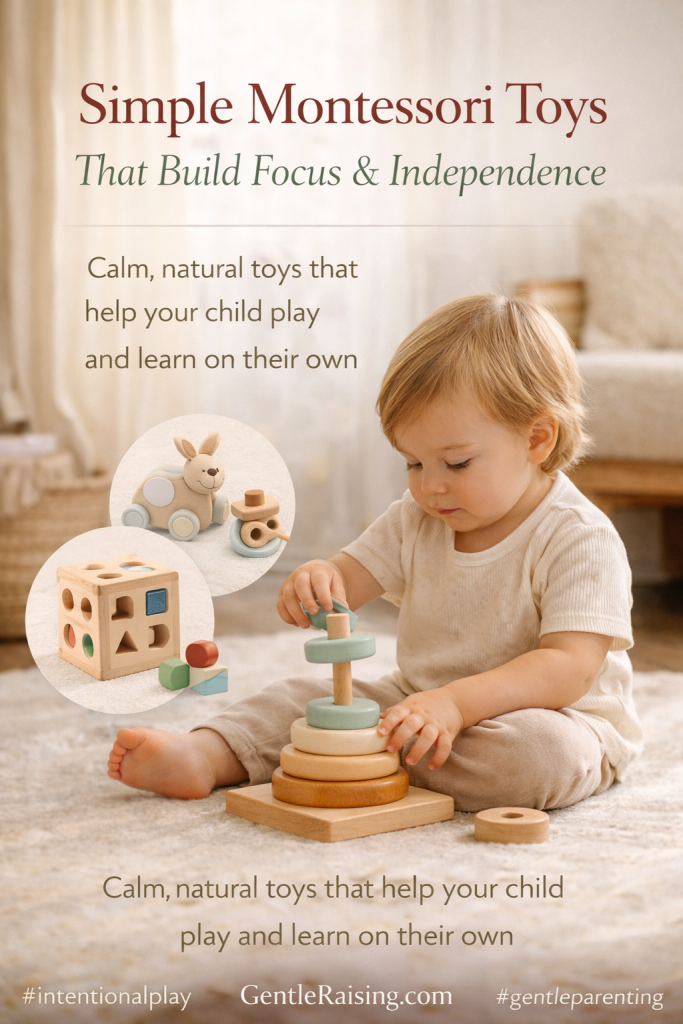
A shape sorter teaches shapes.
A stacking toy teaches balance and size.
A puzzle teaches spatial reasoning.
Nothing extra. No unnecessary bells and whistles.
The idea is simple: when a toy does less, a child does more.
2. Made for Real Hands
Most Montessori toys are made from natural materials, especially wood, cotton, or metal.
Why does that matter?
Because texture matters.
A smooth wooden ring feels different from a soft cotton cloth or a cool metal spoon. Those tiny sensory experiences help babies and toddlers understand the world through touch.
And let’s be honest, they’re usually more durable than plastic toys that mysteriously stop working after two weeks.
3. Designed for Self-Correction
One clever thing about Montessori materials is that they allow children to see their own mistakes.
If a puzzle piece doesn’t fit, it simply won’t go in.
No buzzer. No flashing red light.
The child naturally adjusts, tries again, and learns through experimentation. That process builds problem-solving skills in a very organic way.
4. Encourages Exploration Instead of Entertainment
Many modern toys try to entertain children.
Montessori toys try to engage them.
It’s a subtle difference, but an important one. Entertainment is passive; engagement requires thinking, testing, and observing.
Independent play grows from that kind of interaction.
Why Independent Play Is So Important for Children
Parents often feel pressure to constantly interact with their kids, reading, teaching, entertaining, and guiding.
But children also need space.
Independent play offers several powerful benefits.
Confidence Grows Quietly
When a child solves a problem without help, something important happens.
They think, I did that.
That small moment builds confidence faster than any praise ever could.
Focus Becomes a Habit
You might notice that young children can concentrate for surprisingly long periods when they’re engaged with the right activity.
Montessori educators sometimes call this deep work a moment when a child becomes completely absorbed in a task.
Interrupting those moments can actually disrupt their learning process.
Which brings us to a small but powerful parenting tip: sometimes the best support is simply stepping back.
Creativity Gets Room to Breathe
Open-ended toys, blocks, puzzles, and stacking toys- allow children to invent their own play.
A wooden block tower becomes a castle.
A set of rings becomes a rainbow bridge.
Children don’t just follow instructions. They create.
And creativity thrives in that freedom.
How to Set Up Your Home for Independent Play
You could buy the best Montessori toys in the world, but if your environment feels chaotic or overwhelming, independent play may still struggle.
Montessori environments follow a principle called the prepared environment.
In plain language, it means designing spaces that invite children to explore on their own.
Here are a few simple ways to do that.
Keep Toys Accessible
Store toys on low shelves rather than in deep toy boxes.
When children can see their options clearly, they’re more likely to start playing without asking for help.
Rotate Toys Occasionally
Too many toys can overwhelm children.
Instead, keep a smaller selection available and rotate toys every few weeks. Suddenly, old toys feel new again.
Parents are often surprised by how effective this simple trick can be.
Less Clutter = More Focus
A room filled with toys can actually discourage play.
Children often focus better when only five to eight toys are available at once.
Think of it like a calm workspace rather than a toy store.
Montessori Toys That Encourage Independent Play
Now let’s talk about specific toys that support this kind of play.
You’ll notice a pattern: most of them are simple, tactile, and open-ended.
Object Permanence Boxes
Babies eventually learn that objects still exist even when they can’t see them.
Object permanence boxes help teach that concept.
A baby drops a ball into a hole, watches it disappear, and then sees it roll out again.
It sounds basic, and it is, but the repetition fascinates young babies.
Wooden Stacking Toys
Classic stacking toys help develop:
- hand-eye coordination
- balance
- early math awareness
One popular example is the wooden rainbow stacker from Grimm’s Spiel und Holz Design.
Children use it in dozens of ways, stacking, building bridges, or creating colourful patterns.
Montessori Puzzles
Simple wooden puzzles with knobs help toddlers develop fine motor skills.
Look for puzzles with:
- large pieces
- realistic images
- one clear solution
Many parents love the toddler puzzles made by Melissa & Doug because they’re sturdy and straightforward.
Practical Life Tools
Montessori learning includes everyday life skills.
Child-safe kitchen tools allow kids to participate in real activities like:
- slicing bananas
- stirring pancake batter
- washing vegetables
The goal isn’t perfection, it’s participation.
And honestly, toddlers love feeling helpful.
Shape Sorters
Shape sorters help toddlers recognise patterns and spatial relationships.
Children test shapes, rotate them, and try again until they fit.
That tiny moment of success, when the square block finally slides into place, feels huge for a toddler.
Montessori Busy Boards
Busy boards contain latches, buttons, zippers, and switches.
They mimic real-life objects children see every day.
Brands like Lovevery often include these kinds of materials in their play kits.
Wooden Building Blocks
Blocks are the quiet champions of independent play.
A simple block set can entertain children for years.
Kids build towers, cities, bridges, sometimes things adults can’t even recognise.
That’s the beauty of open-ended play.
Threading and Lacing Toys
Lacing beads or threading animals onto strings helps strengthen the small muscles in a child’s hands.
Those muscles eventually support writing and drawing.
It’s like pre-writing practice disguised as play.
Sensory Bins
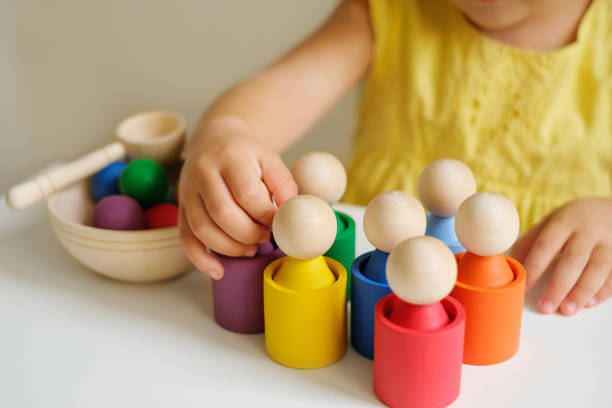
A sensory bin filled with rice, beans, sand, or water beads gives children a hands-on way to explore textures.
Add scoops, cups, or small figurines, and suddenly a simple container becomes a miniature world.
Age-by-Age Montessori Toy Suggestions
Children’s interests change quickly during the early years.
A toy that fascinates a one-year-old may bore a three-year-old.
Here’s a rough guide.
6–12 Months
At this stage, babies explore with their senses.
Good toy choices include:
- object permanence boxes
- soft stacking rings
- textured balls
1–2 Years
Toddlers begin experimenting with cause and effect.
They enjoy:
- shape sorters
- simple puzzles
- stacking toys
2–3 Years
Fine motor skills improve rapidly.
Consider introducing:
- threading beads
- building blocks
- pretend kitchen tools
3–5 Years
Preschoolers love imaginative play.
Open-ended toys like blocks, play silks, and building sets allow creativity to flourish.
A Quick Word About Screen-Free Childhood
Screens are everywhere. Phones, tablets, TVs, they’re part of modern life.
But early childhood experts often emphasise that young children benefit more from hands-on exploration.
When kids manipulate real objects, stacking, pouring, and fitting pieces together, their brains build stronger neural connections.
It’s slower learning, yes.
But it’s deeper learning too.
Common Mistakes Parents Make With Montessori Toys
Even well-meaning parents sometimes misunderstand how Montessori toys work.
A few common pitfalls include:
Too many toys at once
Children don’t need a toy explosion. A few thoughtful options work better.
Interrupting concentration
If a child is deeply focused, try waiting before stepping in.
Choosing toys that do everything
The best toys let the child do the work.
Budget-Friendly Montessori Toy Ideas
Good Montessori toys can be pricey, but they don’t have to be.
Some great options come straight from your home.
Try things like:
- wooden spoons and bowls
- measuring cups
- cardboard boxes
- scarves for imaginative play
Sometimes the simplest items inspire the most creative play.
Final Thoughts: Let Children Lead the Way
Parents often worry about teaching their children everything they need to know.
But children already carry a powerful instinct to learn.
Montessori toys simply support that instinct.
They invite curiosity.
They encourage experimentation.
And perhaps most importantly, they allow children to experience the quiet satisfaction of figuring things out on their own.
And if you ask many Montessori teachers, they’ll tell you something interesting.
The goal isn’t raising children who rely on adults for every answer.
The goal is to raise children who feel confident in finding their own answers.
Independent play is where that journey begins.