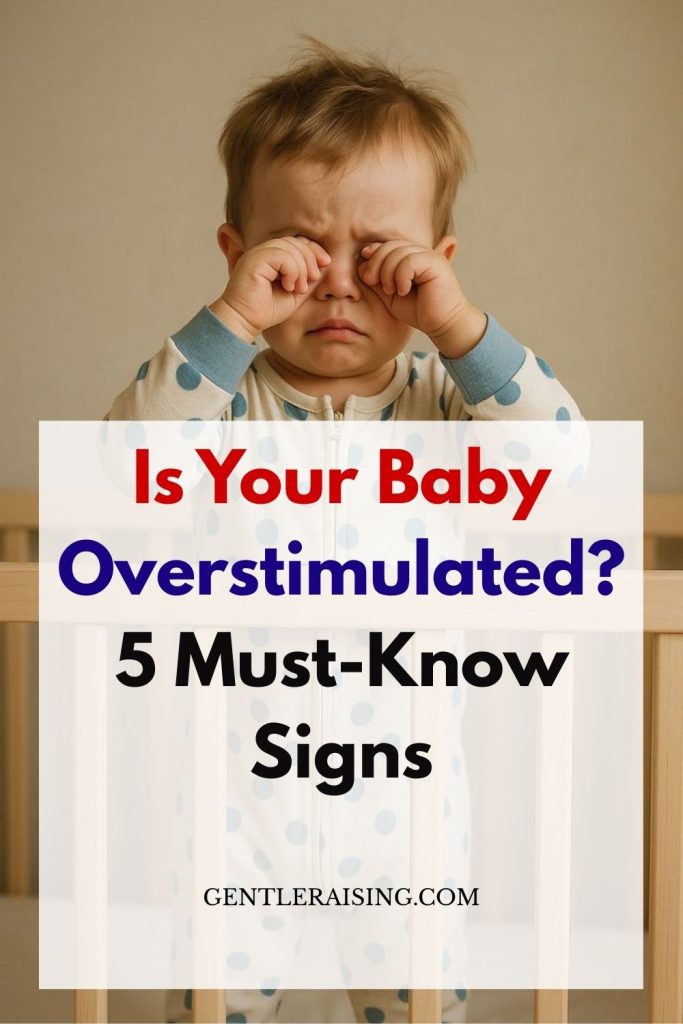
The quiet struggle no one really prepares you for
Your newborn is fed. Clean diaper. Room temperature seems fine. And yet, there it is. The crying that doesn’t quite sound like hunger. The stiff little body. The look that says something is wrong, even if you can’t name it.
Honestly, this is where many parents start to doubt themselves.
Overstimulation isn’t dramatic. It doesn’t come with flashing warning lights or a neat checklist taped to the crib. It sneaks up quietly, often disguised as fussiness, “witching hour,” or what everyone casually calls a fussy baby. But for newborns, overstimulation is very real and very common.
Let me explain what’s actually going on.
What “overstimulated” really means for a newborn
A newborn’s nervous system is brand new. Not “developing,” not “learning,” but brand new, like a laptop fresh out of the box with zero updates installed. Every sound, every light, every touch runs straight through without much filtering.
Adults filter constantly. Babies can’t.
So when we say a newborn is overstimulated, we’re really saying their brain has received more input than it can comfortably process. Noise piles onto light. Movement stacks on top of touch. Smells, temperature shifts, voices, each one adds another layer.
Eventually, the system overloads.
And here’s the part that surprises many parents: overstimulation doesn’t require chaos. It can happen in a calm living room. It can happen during a family visit filled with love. It can even happen during what should be a relaxing outing.
That’s not failure. That’s biology.
Why do some babies get overstimulated faster than others
You might notice something frustrating early on. One baby sleeps through anything. Another loses it over the hum of the fridge.
Temperament plays a role. Some babies are naturally more sensitive to sensory input. Others are more adaptable. Birth experiences matter too; long labours, medical interventions, or early separation can make some babies more reactive for a while.
Environment matters as well. Bright lights. Background noise. Busy schedules. Even well-intentioned stimulation like tummy time, singing, and play can stack up faster than expected.
Here’s the mild contradiction: It’s not your fault, but your choices do influence it.
That’s not blame. That’s power. Once you recognise the signs, you can respond sooner.
The most common signs your newborn is overstimulated
Overstimulation shows up in patterns, not just one-off behaviours. These signs often appear together, especially toward the end of the day.
Physical signs you might notice first
- Stiffening or arching of the back
- Clenched fists or rigid arms
- Rapid movements that seem frantic rather than purposeful
- Turning the head sharply away from faces or light
Behavioural cues that escalate quickly
- Fussing that suddenly turns into intense crying
- Difficulty settling even after feeding
- Short, restless naps instead of deep sleep
- Crying that worsens when you try to engage
Sensory overload signals
- Wide, startled eyes
- Yawning or sneezing repeatedly (yes, really)
- Hiccupping during or after stimulation
- Jerky movements, almost like they’re startled again and again
You know what? Many parents miss the early signs because they look so ordinary. That’s normal.
Early signs vs. late signs (and why timing matters)
Early signs are subtle. Late signs are loud.
Early overstimulation might look like:
- Looking away
- Reduced eye contact
- Slower movements
- Brief fussing that stops when stimulation decreases
Late overstimulation is harder to calm:
- Full-body crying
- Red face
- Difficulty feeding
- Trouble falling asleep despite obvious tiredness
Catching overstimulation early often prevents a meltdown later. But missing it doesn’t mean you’ve “ruined” the day. It just means your baby needs help resetting.
Overstimulation vs. hunger, tiredness, or colic
This part gets messy because the signs overlap.
A hungry baby cries. A tired baby cries. An overstimulated baby cries. Sometimes the same baby is all three at once.
Here’s a helpful distinction:
- Hunger improves with feeding
- Tiredness improves with sleep support
- Overstimulation improves when stimulation decreases
If feeding makes crying worse, or rocking escalates things instead of calming them, overstimulation may be in the mix.
Colic complicates this, too. Some babies labelled “colicky” are actually highly sensitive to sensory input. Not always, but often enough to matter.
What actually causes overstimulation day-to-day
It’s rarely one big thing. It’s an accumulation.
A short car ride. A grocery store trip. Visitors who want to hold the baby. Bright indoor lighting. A TV is playing quietly in the background. A well-meaning sibling talking nonstop.
By evening, it adds up.
Seasonally, overstimulation spikes during holidays and warmer months, more outings, more visitors, more noise. Summer babies often struggle in busy households simply because life is louder.
And yes, screens matter. Even if your baby isn’t watching, the sound and light still register.
How overstimulation affects sleep (even night sleep)
This surprises many parents.
Overstimulated babies don’t sleep better because they’re tired. They often sleep worse. Cortisol, the stress hormone, interferes with settling and staying asleep.
This can lead to:
- Short naps
- Frequent night waking
- Difficulty falling asleep even when exhausted
Ironically, trying to “wear the baby out” often backfires.
What to do in the moment (without overthinking it)
When overstimulation hits, think reduce, don’t add.
Simple resets include:
- Dimming lights
- Turning off background noise
- Holding baby close, chest-to-chest
- Slow, steady movement (not bouncing)
- Quiet humming instead of talking
Some babies calm instantly when stimulation drops. Others need time. That’s okay.
Honestly, this is where intuition matters more than technique.
How to prevent overstimulation without living in a bubble
You don’t need a silent house or a rigid schedule. You need awareness.
Helpful habits:
- Limit back-to-back outings
- Build in quiet breaks after stimulation
- Watch for early cues, not clocks
- Set gentle boundaries with visitors
A flexible routine beats a packed one. Every time.
The emotional side that parents rarely talk about
Overstimulation can make parents feel rejected. “Why doesn’t my baby like being held?” Or worse, “What am I doing wrong?”
You’re not doing anything wrong.
You’re learning your baby’s language. And that language changes weekly.
Comparison culture doesn’t help either. The baby who naps anywhere. The baby who loves crowds. That’s not the standard. It’s just another baby.
When overstimulation is a pattern, not a phase
If your baby seems constantly overwhelmed, struggling to sleep, feed, or calm, even in quiet settings, it’s worth discussing with a paediatrician.
Sometimes, reflux, sensory processing differences, or neurological immaturity contribute. Early support helps. Always.
You’re already learning this skill (even on hard days)
Reading your newborn isn’t instinct, it’s practice.
Every time you notice a turned head. Every time you dim the lights. Every time you choose quiet over “one more thing,” you’re responding. You’re adjusting. You’re parenting.
And that’s the real takeaway here.
Overstimulation isn’t a sign your baby is difficult.
It’s a sign they’re human, and brand new at being here.