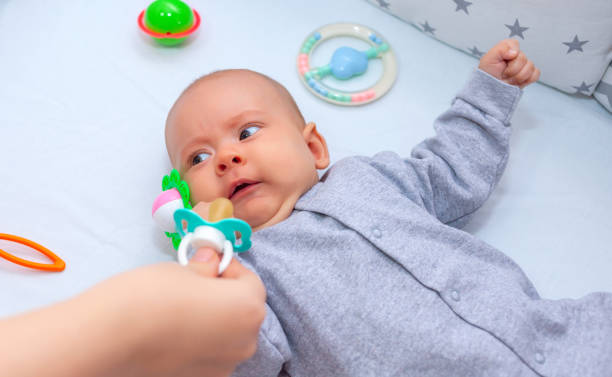
If you’ve ever locked eyes with your newborn and thought, Are they actually looking at me… or through me?You’re not alone.
One of the strangest and most beautiful parts of early parenthood is watching your baby slowly wake up to the world. Not just emotionally. Visually. Their brain is building a brand-new relationship with light, colour, depth, and movement. It’s like installing a brand-new operating system, except the hardware is squishy, adorable, and cries at 3 a.m.
Baby vision development doesn’t happen overnight. It unfolds in stages. Little by little. Week by week. And once you know what to look for, it becomes one of the most fascinating parts of your child’s first year.
So let’s walk through the five major vision milestones from birth to 12 months, what’s normal, what’s amazing, and how you can support your baby’s growing sight without turning your living room into a science lab.
Let me explain.
First, a quick reality check: babies aren’t born seeing clearly
Movies love showing newborns opening their eyes and gazing lovingly at their parents like tiny philosophers. Real life is… blurrier.
Newborn vision is fuzzy. Very fuzzy. Think of it like trying to see through a steamy bathroom mirror. Shapes exist. Light exists. Movement exists. But detail? Not so much.
And that’s okay. Their visual system is still under construction.
A baby’s eyes might look fully formed at birth, but the brain, the real powerhouse behind vision, is still wiring itself. Every time your baby looks at your face, tracks a toy, or stares at a ceiling fan like it’s the most interesting thing in the universe, their brain is building new neural connections.
Vision is learned.
Yes, learned.
That’s why the first year is such a big deal.
How baby vision actually works (without the medical lecture)
Here’s the short version.
Your baby’s eyes capture light. The brain interprets it. The more experiences your baby has with shapes, colours, movement, and faces, the stronger those brain-eye pathways become.
It’s a bit like building internet speed. The more cables you connect, the faster everything runs.
At birth, those cables are just getting plugged in.
Over the next 12 months, your baby’s vision goes from blurry shadows to detailed, coordinated, three-dimensional awareness. They learn to recognise faces, judge distance, reach for objects, and eventually spot you across the room and crawl toward you like a tiny, determined explorer.
Now let’s look at how that unfolds, stage by stage.
Milestone 1: Birth to 2 Months. The Blur Phase
This is the era of squints, stares, and a whole lot of blinking.
Your newborn can see, just not very far. Most babies see best at about 8 to 12 inches away. Coincidentally, that’s about the distance from your face when you’re holding them.
Convenient, right?
At this stage, babies are drawn to:
- Faces
- High-contrast patterns (black and white, especially)
- Light and shadow
- Big, bold shapes
They’re not impressed by pastel nursery decor yet. They want drama. Contrast. Sharp edges.
This is why black-and-white books and toys are so popular for newborns. Brands like Lovevery and Wee Gallery built entire product lines around this exact developmental window.
Your baby may also:
- Briefly track moving objects
- Stare at your face while feeding
- Blink at a bright light
- Look cross-eyed sometimes (totally normal early on)
Here’s the thing: their eyes are still learning how to work together. Coordination takes time.
So if your baby looks at you like they’re trying to solve a riddle, don’t worry. They are. Your face is their favourite puzzle.
Milestone 2: 2 to 4 Months. The “Oh, I Know You” Stage
Something magical happens around this time.
Your baby starts to recognise you.
Not just your voice. Not just your smell. Your face.
You’ll notice longer eye contact. Real tracking. Maybe even that first social smile that makes you forget every sleepless night.
Vision is sharpening. The eyes are working together more smoothly. Depth perception is beginning to form.
Your baby can now:
- Follow moving objects with their eyes
- Recognize familiar faces
- Focus more clearly
- Show excitement when they see you
You may also notice your baby staring at their hands like they just discovered them for the first time. Which, honestly, they did.
Hand-eye coordination is waking up.
And yes, they still love ceiling fans. Some things are timeless.
Milestone 3: 4 to 6 Months. Colour, Reach, Grab
Welcome to the era of grabbing everything.
At this stage, colour vision becomes much stronger. Your baby can now see reds, blues, yellows, and greens with increasing clarity. Pastels still look soft, but bright toys suddenly become very interesting.
Their vision is now sharp enough to guide movement.
Which means:
- Reaching accurately
- Grabbing intentionally
- Bringing everything to their mouth
- Watching objects fall (and finding that hilarious)
Depth perception is improving fast. Your baby is learning how far away things are and how much effort it takes to reach them.
This is also when mirror play becomes fascinating. Babies love seeing another baby in the mirror. Even though they don’t recognise themselves yet, they’re deeply curious.
You might notice longer attention spans during play. More focus. More intent.
Your baby isn’t just seeing anymore.
They’re studying.
Milestone 4: 6 to 9 Months. The Explorer Era
This is where vision meets motion.
Once your baby starts rolling, scooting, and crawling, their visual system has a whole new job: navigation.
They’re now learning:
- How far away objects are
- What’s safe to climb on
- Where furniture ends, and open space begins
- How to move toward what they want
Distance vision improves dramatically. Your baby can spot you across the room. They can watch siblings play. They can track pets like tiny wildlife photographers.
Their brain is now integrating vision with balance and movement. This is crucial for physical development.
You may notice your baby pausing before crawling down a step or approaching a new surface. That’s visual judgment in action.
They’re not being cautious. They’re being strategic.
Milestone 5: 9 to 12 Months. The Mini Researcher
This is where things get impressive.
Your baby now sees in nearly full detail. Depth perception is solid. Object permanence is emerging. They understand that things still exist even when hidden.
Which explains why peek-a-boo is suddenly the best game ever invented.
Your baby can now:
- Recognise familiar people across the room
- Follow pointing gestures
- Track fast-moving objects
- Use vision to problem-solve
- Judge distances while cruising or walking
They’re also reading faces.
Your expressions guide their behaviour. Your smile tells them it’s safe. Your raised eyebrow tells them maybe they shouldn’t touch the dog’s water bowl.
Vision is now deeply connected to emotion, social learning, and language.
It’s not just about seeing.
It’s about understanding.
How to support healthy vision development (without overthinking it)
You don’t need fancy equipment or complicated routines. Honestly, real life does most of the work for you.
Here’s what helps:
1. Face time (the real kind)
Your face is your baby’s favourite visual stimulus. Talk. Smile. Make silly expressions. Let them study you.
2. Tummy time
This strengthens neck muscles and gives babies a new visual perspective.
3. High-contrast toys early on
Black-and-white books and cards are gold in the newborn phase.
4. Colourful toys later
As colour vision improves, bright toys become more engaging.
5. Natural light
Sunlight helps visual development. Walking outside is fantastic for sensory growth.
6. Safe exploration
Let your baby move. Crawl. Cruise. Explore. Vision grows through experience.
You’re already doing most of this without realising it.
Parenting is a masterclass in accidental expertise.
Red flags worth mentioning (not to scare you)
Every baby develops at their own pace. That said, a few signs are worth mentioning to your paediatrician:
- One or both eyes consistently turning inward or outward after 4 months
- Not making eye contact for 3 months
- Not tracking objects for 4 months
- Extreme light sensitivity
- Constant eye shaking
Most of the time, everything is perfectly normal. But early support makes a big difference when something needs attention.
A real-life tangent: screens, guilt, and modern parenting
Let’s talk about the elephant in the playroom.
Screens.
You’ll hear a lot of opinions. Some loud. Some judgmental. Some unrealistic.
The research suggests limited screen exposure in the first year is best for vision and brain development. Babies learn best from real-life interaction. Real faces. Real movement. Real objects.
But here’s the truth: parenting is hard. Sometimes you need five minutes to drink coffee while it’s still warm.
A little screen time won’t ruin your baby’s vision. Chronic, unsupervised screen time isn’t great. There’s a difference.
Balance matters. So does your sanity.
Seasonal and lifestyle factors that quietly shape vision
Vision development doesn’t happen in a vacuum. The environment plays a role.
Babies who spend time outdoors get richer visual input, changing light, moving leaves, wide distances, shadows, and textures. It’s like a sensory buffet.
Different seasons offer different experiences:
- Summer: bright light, vibrant colours, outdoor movement
- Fall: contrast, textures, shifting light
- Winter: softer light, close-range play
- Spring: motion, colour, exploration
All of it feeds the visual brain.
So yes, that walk around the block matters more than you think.
Watching their world come into focus
One day, your baby is staring at shadows.
Then they’re smiling at your face.
Then they’re grabbing toys.
Then they’re crawling toward you from across the room.
And suddenly, you realise, they can see you clearly now.
Not just as a blur.
But as their person.
Their safe place.
Their home base.
Baby vision development is quiet. Subtle. Easy to miss in the chaos of diapers and feeds and nap schedules. But it’s one of the most powerful transformations of the first year.
You’re not just raising a baby.
You’re helping them build their view of the world.
And honestly?
That’s pretty extraordinary.
