Because Moments Vanish
You’re a new mother (or a parent), or soon to be one. Time is slipping, you blink, and another day has gone: nursing, diaper changes, little victories, big anxieties. You want to capture something of the sweetness, of those fleeting glances and half-smiles. But how? A memory jar may be just the small ritual that saves you.
Imagine this: years later, you open a jar and pull out little scraps of paper, “First time he rolled over,” “Mama and baby watched rain together,” “Daddy’s silly dance in the kitchen.” Those tiny notes bring you back. They ground you. They whisper: we were here, we lived this, we loved even in the chaos.
Here’s the thing: memory jars are simple. But simple can be powerful.
What Is a Memory Jar (And Why It Works)
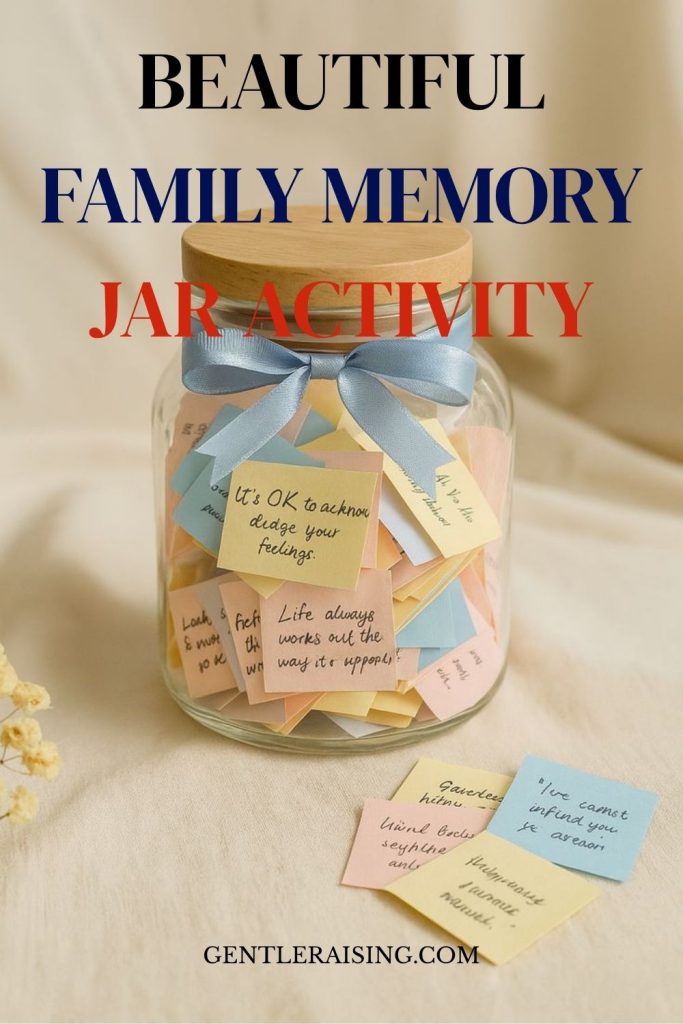
A memory jar is exactly what it sounds like: a jar (or box, or container) in which you place written memories, tiny notes, throughout a period (a year, a baby’s first 12 months, or beyond). At the end, you open it and read them.
Why do people love this idea?
- It’s tangible. You’re not just storing memories in a cloudy head, you’re putting them in a real, touchable jar.
- It slows you down. You pause, you reflect, you notice.
- It becomes a ritual. A shared activity.
- Over time, you build a mosaic of your life’s moments, the big, the small, the in-between.
- In tough days, when sleep is low, it reminds you: there have been beautiful, ordinary things.
It’s not new. People have done journal jars, gratitude jars, and memory boxes forever. But for new parents, it hits deep: you realise how much slips away.
Getting Started. Materials, Timeline, Setup
You don’t need fancy things. You’ll laugh later that you fussed over jars when any old container works. Let me walk you through.
What you’ll need:
- A jar, glass or acrylic, with a lid
- Paper slips or small note cards (you can cut colored paper)
- Pens (maybe a special pen you like)
- Optional extras: stickers, labels, washi tape, colourful envelopes
- A calendar or reminder tool
When to start, and over what span:
You can start the very day your baby is born (or even in pregnancy). Many people pick a one-year “first-year” jar. Others do “every year” or “baby to age five.”
I suggest: Start immediately if you can. But don’t worry if days have passed, just start now.
Where to keep it:
Keep it visible. On a shelf, on the dresser, on a corner of the nursery. If it’s tucked away, it’s easier to forget.
Maybe also have a mini jar or envelope you carry in your diaper bag, for little notes when you’re out and about.
Setting expectations:
You don’t need a memory every day. Heck, you may forget many days. That’s okay. The goal is consistency over perfection.
Making It Fun, Variations, Prompts, Themes
You know how a blank page sometimes scares you? A blank prompt list can be the same. So here are twists and ideas to keep things fresh.
Prompt ideas, when you don’t know what to write:
- “Today I smiled when…”
- “Baby’s funniest sound”
- “Mama was proud when…”
- “Daddy did this silly thing”
- “Something unexpected that happened”
- “A little victory”
- “A struggle I want to remember because…”
- “Today’s surprise”
Rotate prompts every week or month. Use sticky notes of prompt ideas that you draw randomly.
Themed jars:
- Gratitude jar (focus on “thankful” memories)
- Milestone jar (focus on baby’s “firsts”)
- Challenges & triumphs jar (for the tough stuff too)
- Travel or holiday memory jar
- “Letters to future self” jar
Creative twists:
- Use photos: small prints or Polaroids, with a short caption
- Use voice memos: record a short voice note on your phone, then write its summary
- Use drawing: if you or your toddler draws a scribble, stick it in, with a date
- Use color codes: green papers = happy moments, red = challenges, yellow = surprises
You can adapt methods as the baby grows. Later, your toddler may write or draw directly.
Involving Everyone. Building a Shared Memory Habit
This isn’t just a “mom project.” It can become part of your family’s culture.
Encouraging your partner (or spouse) to join:
You might say: “Hey, just one line today about something you saw baby do.” Even if it’s “She slept 3 hours straight,” that’s something.
Work it into conversations at dinner or bedtime. Gentle reminders help, don’t pressure.
Older siblings or other relatives:
If there’s a toddler, give them “memory cards” too. Their perspective is gold.
Grandparents love this. Invite them to add a memory when they visit.
Friends visiting can scribble a line.
Team effort vs solo pursuit:
Some months you’ll be doing most of the writing. In other months, your partner may be more active. That’s fine. The jar doesn’t judge.
Rituals Around the Jar — Making It a Practice
Putting notes in a jar is more than a random act. When you layer ritual, it becomes meaningful.
Regular check-ins:
Pick a time, weekly, bi-weekly, or month’s end, for “jar time.” Coffee in hand, baby in carrier, just you (or with your partner). Read a few, laugh, cry, remind yourself why you’re doing this.
Decorating & labelling:
Let each year or child have a label. “Baby A, Year One.”
You might wrap a ribbon, glue a photo on the jar.
Use Post-it flags to divide the jar (quarters of year 1, 2, etc.)
“Memory jobs” rotation:
Decide who writes on which day. Maybe Monday is “mom’s day,” Wednesday “dad’s day,” Sunday “free choice day.”
Use a phone reminder (I use Google Tasks or a simple alarm) so you don’t forget.
Protecting the habit:
If you miss many days, don’t beat yourself up;p, gently pick up.
Store a stack of blank slips next to the jar. Keep extra pens handy.
Do a “catch-up note” when you remember something late. Better late than never.
Using The Jar — When (and How) To Open It
This is where the magic happens.
At the end of the first year (or your chosen period):
Gather as a family. Dump out the notes. Read them aloud.
You can make it a mini celebration, treats, cake, and photographs.
You’ll laugh. You’ll tear up. You’ll remember details you’d forgotten.
Birthdays, anniversaries, “hard days”:
Whenever someone’s having a rough day, open a few.
Use it in therapy, in reflection, as reassurance.
Save some for future moments, when the baby is grown and prying into mom’s old boxes.
Create a keepsake:
After reading, you can bind the notes in a scrapbook; glue them onto decorated pages, insert photos, and add commentary.
You might transcribe (digitally) the notes into a document, maybe to share later with your child.
Or leave the jar as-is, sealed, to be opened when your child is older (say, age 18 or 21).
Troubleshooting & Tips (When Life Happens)
Because, let’s be honest, life is messy, especially with a newborn.
You forgot for weeks:
Don’t scrap the jar. Write a “catch-up” note: “From July 5–15, I was too tired, but I do remember…” Fill in what you can.
Make shorter notes when busy (“She smiled,” “Baby pooped,” “We walked”).
You feel you don’t have anything memorable:
Cue: there is something daily, however small. Even “Baby gazed at me, slept on my chest” counts.
Don’t pressure yourself to find poetic or grand. Simple sincerity is better.
Time constraints fatigue
Set a minimal goal: one note per week is enough.
Dictate a note into your phone, then later write it down.
Use index cards you can stash in your pocket and jot whenever.
Overwhelm:
If the jar becomes yet another task, pause. Let it rest for a week. Then restart when you feel ready.
If writing too many notes is stressful, simplify: only one per week or per month, or limit yourself to “happy moments” only.
Emotional Benefits for New Mothers & Parents
I want to pause and really acknowledge this: for new mothers (and parents in general), the mental load is heavy. Memory jars aren’t just cute crafts. They are small anchors, emotional lifelines.
- Self-validation: On days you feel invisible, you see your own narrative, the mom who stayed up, who whispered stories, who held tiny hands.
- Perspective: When babies cry, deadlines loom, you may lose sight of the little wins. The jar brings them back.
- Healing: On postpartum or anxious days, reading notes helps you see how far you’ve come, the journey itself.
- Legacy: This becomes a gift, a bridge between you and your child years later.
When you’re juggling diapers and deadlines, it may feel silly to slow down. But in doing so, you pay attention to what really matters.
Real-Life Stories (Mini Vignettes)
Here are a few stories (names changed) that show how memory jars live.
- Maria, a new mom in Kampala, started her jar in Week 2. One day, she wrote: “He grabbed my necklace and tried to chew it.” At year’s end, she laughed so hard she nearly jumped jar.
- Chris, a sleep-deprived dad, resisted the idea. But he agreed to write once a month. His note: “She giggled when we played peekaboo outside in the rain.” Later, he said he found himself wanting to observe the baby more. The jar became his quiet way of paying attention.
- Aisha, whose mother-in-law visits often, asked her to add a memory when she came. The grandmother wrote: “She held the baby’s hand and asked, ‘Are you my granddaughter?’” That’s one of the most precious slips.
These are small entries. But when read in a group, they built a textured, living story.
Growing the Jar Over Time
You don’t have to stop after Year 1. In fact, as your child grows, the jar evolves.
- When a toddler starts speaking, let them dictate their memory or draw and label
- Use the jar for family vacations: “Best moment” slips
- Use it for school years: “third grade jar,” “teenage jar”
- Let your child eventually take ownership: redesign the jar together, select notes to keep, discard, or expand
Seasonal or Trend Tie-Ins
If you start in December (for example), you can call it a “New Year memory jar.”
Around Mother’s Day, Dad might pre-write a few notes as a surprise.
During festive seasons (holidays, harvest times), focus some prompts on gratitude, lights, smells, food, and rituals.
If there’s a social media trend (say, a “30 days of gratitude”), you can tie your memory jar prompts to that, but with your own twist.
Final Thoughts & Encouragement
You may read this, thinking, “I don’t have time for another project.” But the memory jar isn’t a project, it’s a companion. It’s the small pause, the tiny act of noticing, the whisper to your future self that you tried, you cared, you saw.
Start with one slip a week if that’s all you’ve got. Start with one sentence. Start now, not tomorrow. The jar is forgiving.
Someday your child (if you have one) may ask: “Mom, what was I like as a baby?” You’ll smile, reach for that jar, and read aloud. Time will feel more like a rich tapestry than a blur.
Go get a jar. Cut some paper. Start scribbling. You won’t regret it.